
Learn About
upcoming elections
Vote YOUR Way!
Life gets busy. Alaska gives you options.
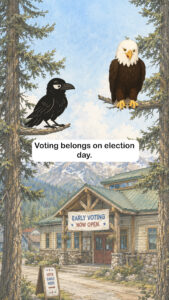
Why mail-in voting?
or Should we only vote on election day?
|
Key Dates — 2026 |
|
PRIMARY ELECTION — August 18, 2026 (COMPLETED)
Pick ONE candidate; the top four advance. No ranking in the Primary. For more on our Open Primary system, see “Understanding the Primary” (Step 2) below. |
GENERAL ELECTION — November 3, 2026
Rank candidates 1–4. Candidate with over 50% wins. You don’t have to rank every candidate. If a candidate wins a majority in the first count, rankings aren’t used. For more information see “Understanding the General” (Step 4) below. |
Understanding Alaska’s Elections – Your Guide to the 2026 Election
The 2026 election season includes two statewide elections: the Primary Election on August 18 and the General Election on November 3. Whether you’re voting for Governor, U.S. Senate, U.S. House, or your state legislators, this guide will help you understand Alaska’s election process, learn what’s on the ballot, and find reliable information before you vote.
Choose a topic below to get started. Click any section to expand for more information.
STEP 1
Get Ready to Vote
Ballot information, Register to Vote, Check Registration.
STEP 2
Understand the Primary
Alaska’s Open Primary – how it works, So many choices, You choose!
STEP 3
Vote YOUR Way!
Absentee by Mail, Early in-person, or Election Day.
STEP 4
Understand the General
Ranking candidates is easy! Common Questions about Ranked Choice Voting.
STEP 5
Follow the Results
When do results come in and why does it takes time?
STEP 1 — GET READY TO VOTE
What's on my ballot?
Federal offices (even years): U.S. Senate, U.S. House (Alaska’s at-large seat)
State offices (even years): Governor & Lt. Governor, State Senate, State House
Ballot measures (any election): Statewide questions voters decide directly
Local offices (varies): Check your municipality separately
The Official Election Pamphlet is mailed to every Alaska household before the General election. It provides information about candidates and any ballot measures appearing on the ballot, how to vote, voting locations, absentee voting, and voter rights. The digital (pdf) version of the OEP is available in select languages including English, Tagalog, and targeted Alaska Native languages.
View Candidate List ► View the General Election Pamphlet (October) ►
Am I Registered?
If you’ve applied for a Permanent Fund Dividend or gotten an Alaska Driver’s License, you may already be registered. But registration can go inactive if you’ve moved, changed your name, or haven’t voted in a while. Check before every election!
Register via Phone or Walk-in? Contact your Regional Elections Office by phone or in person. Have ready: your name plus one identifier (voter number, Alaska driver’s license or state ID number, date of birth, or last four of your SSN).
Registering online? You’ll need a valid Alaska driver’s license or state ID, and your info must match your DMV record. If it doesn’t match, or you don’t have a valid ID, you can register using a paper form instead. You can also request a new voter ID also using either method.
Never Voted Before?
Voting for the first time can feel overwhelming — but it doesn’t have to be.
- Make sure you’re registered — see Am I Registered? above.
- Find out what’s on your ballot — give yourself time to learn about the candidates and measures before Election Day. Read the Election Pamphlet, or search for candidate information.
- Choose how you want to vote — by mail, early in person, or on Election Day. All three are valid options. More information in Step 2!
- Show up — or mail it in — bring your ID, follow the instructions, and you’re done. Election workers are there to help.
Never Voted Before? Watch the YouTube short! (coming soon) ►
STEP 2 — understanding the primary
How Alaska's Primary Works
Alaska uses a Top-Four Open Primary. Here’s what that means and why it works differently than some other states.
One ballot, Every candidate. In a closed or political party primary, you only see candidates from one party (unless the party decides to show anyone else). That means the political party is choosing who they want on their ballot. If you don’t belong to a specific political party (and most Alaskans don’t) then you might not get to vote in their primary. If you wanted to vote for one party for one race, and a different party for another race, you couldn’t do that in a primary election. Now, with Open Primaries, EVERY qualified candidate for a race – regardless of their party or even if they aren’t part of a political party- every candidate who meets the requirements appears on the same primary ballot. There is no separate Democratic ballot or Republican ballot.
Every registered voter votes the same ballot. You don’t have to declare a party or pick a “side” to participate — everyone votes in the same primary, for the same set of candidates.
Pick just one candidate per race. Unlike the General Election in November, you don’t rank anyone in the Primary — you choose a single candidate for each race on your ballot.
The top four advance. Whoever finishes in the top four spots in each race — regardless of party — moves on to the General Election in November. It’s possible for four candidates from the same party to advance, or for all four to be from different parties. The number of votes decides it, not party rules.
This system means your primary ballot may look longer than what you’re used to — but it also means no one is filtered out by others before you get a chance to vote.
So Many Candidates? How Do I Choose?
In Alaska’s open primary, every qualified candidate runs on the same ballot — there’s no party limiting who you see. You decide. It seems like a lot, but you don’t need to research every candidate in depth.
Before you start, find your precinct information (this will locate your Alaska State House and State Senate districts as well as tell you where your polling place is located): Precinct Locator ►
- Start with the statewide races. Every Alaska voter will see the same races for Governor, U.S. Senate, and U.S. House. You can begin researching those candidates as soon as the official candidate list is available. On this candidate list you can find their email addresses, their website links and more. (Now is a great time!) View the candidate list ►
- Narrow the field. Identify some of the candidates you’d like to learn more about. Check out their website. What is their party affiliation (or independent, etc.)? What are their ties to Alaska? Are they actively campaigning and reaching out to Alaskans? If they’ve been in public service before, research their record and what they did while in office.
- Compare candidates side by side. Look at their experience, their stated priorities, and coverage from candidate forums or local news. Use more than one source. Don’t be misled by campaign ads, either positive or negative — check out the claims. (Some additional research links below.)
- Decide what matters most to you! No candidate will match you on everything. Decide which issues matter most to you, and which candidate seems most prepared for the job. Talk to your neighbors, friends and family. Gather the information, then think for yourself.
- Then, do the same for your local state legislators. Find out your House and Senate districts (above). State Senate and State House races vary by district and usually have fewer candidates. You may not even have a Senate race this cycle — Senators serve 6-year terms, and only half the seats are up for election each cycle. With fewer candidates, these races are often easier to research and compare. Try to meet them in person at candidate forums or events.
Remember — you only vote for one candidate per race in the Primary. The top four advance to the General Election. You don’t have to make a perfect choice — just an informed one.
Ballot Initiatives - Primary Election - PASSED
UPDATE for 2026: Ballot Measure 1 passed.
A ballot initiative lets Alaska voters decide directly on a proposed law or policy instead of the Legislature making the final decision. Citizens who want to change a law gather signatures from registered voters. If enough valid signatures are collected, the measure is placed on the ballot for voters to decide with a “Yes” or “No” vote.
Ballot Measure No. 1 – An Act Restoring Campaign Contribution Limits for Campaigns for State and Local Office (Initiative 23RCF2). This act would change the amount of money that people and groups can give to state and local political campaigns. A 2021 court ruling removed Alaska’s existing limits on individual contributions. Under this measure, individuals could give up to $2,000 per election cycle to a candidate and $5,000 a year to a political party or group; groups other than parties could give up to $4,000 per election cycle to a candidate and $5,000 a year to another group or party. Contribution limits would shift from an annual basis to a per-election-cycle basis, and would be adjusted for inflation every ten years beginning in 2031.
Supporters argue that without limits, a small number of wealthy donors — including those from outside Alaska — can have an outsized influence on state and local races, and that restoring limits helps protect the integrity of elections and gives everyday Alaskans a more equal voice. They also point to a 2006 vote in which 73% of Alaskans approved similar contribution limits.
Opponents, including several former Alaska legislators, argue that contribution limits restrict political speech and make it harder for new or lesser-known candidates to raise the funds needed to compete with incumbents. They also argue that a ten-year gap between inflation adjustments is too long to keep pace with rising costs.
Read the full Ballot Measure Pamphlet — ballot measure information begins on Page 17. ►
Additional Resources
Not every source online is reliable. As you research candidates, look for nonpartisan, fact-based information — and check more than one source before forming an opinion.
Sample Ballots
See exactly what will be on your ballot. Posted approximately 50 days before each election.
Sample Ballots — Division of Elections ►
Candidate Forums & Debates
Many local League of Women Voters chapters host candidate forums and debates. Check with your local league for upcoming events.
Find Your Local League ►
Division of Elections — Full Site
The official source for registration, candidates, ballot measures, results, and more.
elections.alaska.gov ►
LWV Alaska Election Videos
Short, nonpartisan videos explaining Alaska’s voting process.
LWV Alaska YouTube Channel ►
More Nonpartisan Research
- Ballotpedia — nonpartisan encyclopedia of candidates and races, including down-ballot races
- Alaska Public Media — nonprofit, statewide election coverage
- Alaska Beacon — nonprofit, statewide political and policy coverage, no paywall
STEP 3 — Vote YOUR Way
Vote by Mail / Online / Fax
Any registered voter can request a mail ballot — no excuse needed.
- Request early — apply online, by mail, fax, or email starting January 1st. Don’t count on mail delivery. Official deadline is 10 days before the election — don’t wait!
- Choose how to receive your ballot — by mail, by Online Delivery (sent to you electronically), or by Fax (mainly for military and overseas voters).
- Fill it out carefully — mark choices, place ballot in secrecy sleeve, then into return envelope.
- Sign in front of a witness — both you and your witness (18 or older) must sign the return envelope. Required — unsigned ballots will not be counted.
- Return it — by mail (postmarked on or before Election Day), drop box, or any voting location by 8:00pm Election Day.
- Absentee and Vote by Mail can get complicated. For full directions and details, see Division of Elections ►
Postage: You pay — budget for two stamps. Don’t rely on the USPS forwarding it without the proper postage.
Online Delivery: Get your blank ballot sent to you electronically instead of waiting on the mail — useful if you’re traveling, working remotely, or applied close to a deadline. You’ll need an email address, a computer, and a printer. After marking your ballot, print it and return it the same way as a regular mail ballot. Returning it by mail keeps your vote secret, just like a regular mail ballot.
Fax: Mainly for military and overseas voters who need the fastest possible return. Returning your ballot by fax means giving up your right to a secret ballot — the Division of Elections says voting by fax waives ballot secrecy. Most voters should avoid this option unless there’s no other way to return your ballot in time.
⚠️ Alaska Mail Warning:
Alaska mail can take extra time to receive a postmark. Mail your ballot early. Your ballot must be postmarked on or before Election Day. A late postmark means your ballot won’t count. Send it back quickly. If you are mailing too close to Election Day, and you have a post office nearby, ask the clerk to hand-cancel it at the counter. Or bring it to an early voting location, a drop box if one is available in your area, or deliver it in person (if possible) on Election Day.
Apply for Absentee Ballot ► See if your Absentee Ballot was sent ►
Absentee In Person/Early Voting
Early voting begins 15 days before each election — open multiple days including some weekends. No need to take Election Day off.
Alaska has two early in-person options — they look similar but work differently:
Early Voting — Your registration is verified live, you vote and insert your ballot into the scanner. Counted on Election Night. Available at select locations only.
Absentee In-Person — Available at more locations. You complete your ballot ahead of time and put it in the security sleeve and envelope. Then bring it to an election location and an election worker witnesses your signature, so no separate witness needed. It is counted with the rest of the absentee ballots after Election Day.
Vote on Election Day
Vote at your assigned polling place — the location tied to your registered address.
- Show your ID to the election worker.
- Give your name — worker looks you up in the system.
- Vote privately in a booth. Made a mistake? Ask for a replacement ballot before scanning — you can start fresh.
- Feed your ballot into the scanner or place it in the ballot box if a scanner isn’t available, and you’re done.
In line by 8:00pm? You will be allowed to vote. Do not leave.
No ID? Ask for a questioned ballot — the election worker will help you.
Find My Polling Place via Election Map ► Find My Polling Place via webpage lookup ►
📋 What to Bring
Alaska does not require a photo ID. Any of the following are acceptable:
- Alaska Driver’s License or State ID
- Voter Registration Card
- U.S. Passport
- Hunting or Fishing License
- Current utility bill, bank statement, paycheck, tribal ID, or government document showing your name and current address
No ID or questioned ID? You can vote a questioned ballot — see Need Help? below.
STEP 4 — understanding the General
How Voting Works in the General Election
Alaska uses Ranked Choice Voting in the General Election. Here’s what that means and why it works differently than traditional elections.
Rank your choices, or just pick one. In the General Election, you can rank up to four candidates in order of preference: 1st choice, 2nd choice, 3rd choice, and 4th choice. You don’t have to rank everyone if you don’t want to — voting for just one candidate is always allowed.
Your vote counts for one candidate at a time. Your ballot never counts twice or gives you extra voting power. If your first-choice candidate is still in the race, your vote stays with them. It only moves to your next choice if your first choice has already been eliminated.
Counting happens in rounds. First, every voter’s first choice is counted. If one candidate receives more than half the vote, they win immediately. If not, the candidate with the fewest votes is eliminated, and those ballots move to each voter’s next ranked choice. This continues, round by round, until one candidate has support from a majority of the active votes.
The winner has real majority support. Before Ranked Choice Voting, a candidate could win with far less than half the total vote — sometimes only 35–40% — if several candidates split the field. With ranking, counting continues until one candidate earns support from more than half of the votes still active. The winner has broader support than a candidate who simply got “the most votes” in a crowded field.
This system means your ballot looks a little different than what you may be used to — but ranking additional choices gives your vote more chances to influence the final outcome if your top pick doesn’t win. By the General Election, you’re only ranking up to four candidates, all of whom already made it through the Primary. A little extra thought goes a long way.
View Division of Elections RCV information ► See the Official RCV Counting Guide ►
Common Questions about Ranked Choice Voting
Ranked Choice Voting is still new to many Alaskans, and people have lots of questions about how it works. Here are answers to some of the most common questions we hear.
“Does Ranked Choice Voting violate ‘one person, one vote’?”
No. Every voter gets one ballot, and that ballot counts for only one candidate at a time, in every round of counting. Your vote never counts twice, and it never gives you extra voting power compared to anyone else. Think of it this way: ranking candidates is like giving instructions in advance — you’re saying, “If my first choice is eliminated, here’s who I’d like my vote to support next.” Instead of coming back weeks later to vote again, you’ve already provided your backup choice on the same ballot, on the same day. Every voter has exactly the same opportunity to rank candidates, or to vote for just one candidate if they prefer. One person, one vote, same as always.
“Will ranking a second choice hurt my first choice?”
No — never. Your second choice only gets counted if your first choice has already been eliminated. The two choices are never in competition with each other. Ranking more candidates can only help you — it never takes anything away from your top pick.
“What if all my ranked candidates lose? Doesn’t my vote get thrown out?”
If every candidate you rank gets eliminated, your ballot doesn’t count toward the final round — this is called an “exhausted” ballot. But here’s what’s easy to miss: this can never put you in a worse position than a traditional one-choice vote. If your one favorite loses in a regular election, your vote simply doesn’t count toward the winner, period — it never gets a second chance. With ranking, your vote gets up to three more chances to matter. The only way your ballot exhausts early is if you choose to rank fewer candidates — and that’s your choice, not a flaw in the system.
“How will I know when and why my candidates were eliminated?” The Division of Elections publishes a full report after tabulation showing how many votes each candidate had in every round, and how votes were transferred when candidates were eliminated. A summary report shows the final tally for the winning candidate. Nothing about your vote’s path through the rounds is hidden.
“Doesn’t the winner end up without a real majority anyway?”
In ranked-choice voting, the winner always ends up with more than half the vote in the final round — that’s the rule. But “more than half” means more than half of the ballots still active at that point, not necessarily more than half of every single ballot cast at the start. Some ballots may have exhausted along the way if a voter didn’t rank enough candidates. Here’s the comparison that matters: in a traditional election with three or more candidates, the winner is often whoever gets the most total votes, even if that’s only 35–40% of the total. The other 60–65% of voters get no say in narrowing it down further. Ranking raises the bar — the winner has to earn the support of a majority of voters whose ballots are still active, which is more than a traditional plurality system ever requires.
“Isn’t ranking a lot more work than just picking one?” By the time you get to the General Election, you’re only ranking four people — not a long list. That’s not much harder than picking just one. And a little extra thought is actually a good thing here. You can’t just vote for your side and assume they’ll win automatically — you have to think about who else you’d accept. That makes people pay closer attention, which is a good thing.
“Why can’t I just vote for one person like I always have?” You can! Ranking beyond your first choice is completely optional — nothing requires you to rank more than one candidate. If you only vote for one person, your ballot works exactly like it always has. But ranking a second or third choice costs you nothing and only gives your vote more chances to count if your first choice doesn’t win.
“Why do we rank candidates instead of having a runoff election?” Alaska doesn’t use runoff elections — that’s not how our system works, with or without ranking. Here’s what Alaska actually does: with Ranked Choice Voting, whoever gets more than 50% of the vote — in whatever round that happens — wins. Before RCV, a candidate could win with less than 50%, simply by getting more votes than anyone else, even if that was only 35–40% of the total. In the rare case of an exact tie, the winner is decided by lot — usually a coin flip. This is true whether or not ranking is involved, and it’s happened more than once in Alaska’s history.
“Why does it take so long to get results?” It doesn’t always. Most races are decided outright once first-choice votes are counted, the same as a traditional election. In the small number of races that are both close and split among several candidates, every vote matters — including those still arriving from rural Alaska. So the delay comes from Alaska allowing extra time for ballots to arrive from remote communities — which existed before Ranked Choice Voting. Once all the votes are in, the actual counting of ranked votes is fast — in 2022, Alaska’s ranked-choice races were tabulated live on TV. See our Follow the Results section for the details.
Ballot Initiatives - General Election
A ballot initiative lets Alaska voters decide directly on a proposed law or policy instead of the Legislature making the final decision. Citizens who want to change a law gather signatures from registered voters. If enough valid signatures are collected, the measure is placed on the ballot for voters to decide with a “Yes” or “No” vote.
Ballot Measure #2 – An Act Restoring Political Party Primaries, Ending Ranked-Choice General Elections, and Repealing Recent Campaign Finance Laws. This act would get rid of open primary elections, where all candidates appear on one ballot. It would also get rid of ranked-choice general elections. It would bring back political party primaries and single-choice general elections. In the primary election, voters would choose a party’s ballot and could only vote for candidates on that ballot. The winning candidate from each primary would be the party’s nominee. In the general election, voters would vote for only one candidate in each race, and the candidate with the most votes would win. This act would also repeal campaign finance rules passed in 2020, including limits on donations to joint campaigns for governor and lieutenant governor, and disclosure rules for digital ads, out-of-state donations, undisclosed donations, and the true source of donations.
Supporters, organized as Repeal Now, argue that ranked choice voting is confusing for many voters, and that the current system has weakened the ability of political party members to choose their own nominees. They also argue that the campaign finance disclosure rules infringe on donors’ free speech rights.
Opponents, organized through Alaskans for Better Elections, argue that ranked choice voting produces fairer results than the prior system, which allowed candidates to win elections with less than a majority of votes. They also argue that returning to party-controlled primaries would let political parties decide who is allowed to vote in their own primary — as was the case before 2022 — rather than letting every voter choose from every candidate across party lines. Finally, they argue that repealing the campaign finance disclosure rules would make it harder for voters to know who is funding political campaigns. Both sides of the repeal effort are relying heavily on out-of-state funding.
Read the official ballot title and summary ►
Ballot Measure #3 – An Act Addressing Voter Qualification. Alaska law already requires that a voter be a United States citizen. This initiative would change the wording of the statute from “a person may vote who is a citizen” to “only a person who is a citizen… may vote” — closing what supporters describe as a theoretical gap, even though current law already limits voting to citizens at every level. Citizenship is already required to vote in Alaska in three separate ways: federal law makes it a crime for a noncitizen to vote in any federal race; the Alaska Constitution requires citizenship to vote in any state or local election; and state statute reinforces the same requirement specifically for municipal elections. No Alaska municipality currently allows, or has proposed allowing, noncitizen voting.
Supporters, including several former state legislators, say the change provides clearer, more explicit language and guards against any future legal challenge to the existing rule.
Critics have questioned why the measure is needed at all, since the underlying rule is already in place at every level and has never been challenged in Alaska.
STEP 5 — follow the results
Primary Election Results
Primary results are straightforward — the top four vote-getters in each race advance to the General Election. There’s no ranking, no rounds of counting, just a simple count of who got the most votes.
Election Night: First unofficial results are posted after 9:00pm on Election Day. These numbers are never final — and that’s completely normal. In most races, the top four are clear that night; only races with a close contest for the fourth spot may not be decided until all ballots have been received and counted.
Mail ballots: Absentee ballots returned by mail must be postmarked on or before Election Day (August 18). Ballots continue to arrive and be reviewed in the days that follow and must be received by the Division no later than August 28 to be counted.
Why it takes time: Many ballots, especially from remote Alaska communities, have to physically travel by plane or boat before they even reach a regional office for review. Absentee, questioned, and remaining ballots are reviewed by bipartisan boards before being counted.
Certification: The Primary Election is targeted to be certified by August 31.
View Current Election Results ► See if your Absentee Ballot was received ►
General Election Results & RCV Tabulation
Preliminary, unofficial, results begin posting after polls close at 8:00pm on Election Night. These numbers are never final — and that’s completely normal. In many races, the preliminary count makes the outcome obvious that night; only a smaller number of close, multi-candidate races may need additional tabulation rounds.
Mail ballots: Absentee ballots returned by mail must be postmarked on or before Election Day (November 3). Ballots continue to arrive and be reviewed in the days that follow. Domestic ballots must be received no later than November 13. Overseas and military ballots have until November 18.
Why it takes time: Many ballots, especially from remote Alaska communities, have to physically travel by plane or boat before they even reach a regional office for review. Absentee, questioned, and remaining ballots are reviewed by bipartisan boards before being counted.
RCV Tabulation: If a race isn’t already decided, tabulation rounds begin in Juneau once all ballots are counted — targeted for November 20. Most races are decided in Round 1 if a candidate already has more than 50% of first-choice votes. If not, counting continues in rounds until one candidate reaches a majority. The Division publishes a full report showing how many votes each candidate had in every round, and how votes were transferred when candidates were eliminated.
Certification: All results remain unofficial until the State Review Board completes its review and the election is certified — targeted for November 25.
Recounts: Close races can be recounted. A recount request for Governor or Lieutenant Governor must be filed within 3 days of certification; for any other office or ballot measure, within 5 days. A recount doesn’t mean something went wrong — it’s a normal, available check when a race is close.
See the Official RCV Counting Guide ► View Current Election Results ► See if Your Absentee Ballot Was Received ►
NEED HELP?
Moved?
Update Your Registration ►
Name Changed?
No ID?
Not on the Voter List?
Can't get to the polls?
What's a Questioned Ballot?
Need assistance at the polls?
Special Needs voting?
Need language assistance?
Contact the Division of Elections
Toll-free: 1-866-952-8683
Link: Contact the Division of Elections → https://www.elections.alaska.gov/contact-information/